For puppy training, feeding time makes a big difference
September 2, 2026
My husband and I have been married for 45 years—a milestone that is definitely worth celebrating. During those years, we’ve shared our home with many wonderful dogs of different breeds. We’ve experienced the excitement of bringing home playful puppies, the satisfaction of watching them grow into well-mannered companions, and the heartbreak of saying goodbye to beloved friends who each hold a special chapter in our family’s story.
Throughout our years as dog owners, our goal has always been the same: to raise dogs that are well-behaved, well-socialized, and emotionally balanced. The one exception was a tiny Chihuahua named Beanie. She was my daughter’s high school graduation gift, and despite all of our efforts, Beanie simply never warmed up to strangers. At just four pounds, she was full of fierce determination—growling, snarling, and doing her best to convince every new person to keep their distance. Yet behind that tough little exterior was a dog who adored our family completely. We loved her just as she was, quirks and all, and we were heartbroken when we lost her after a long, happy life.
Many evenings during those years were spent watching The Dog Whisperer with Cesar Millan. It was through his television series that we were first introduced to the importance of teaching dogs impulse control. One of the simplest lessons became one of the most valuable. We learned to hold our dogs’ food bowls until they calmly waited for permission to eat. To this day, every one of our dogs waits for the verbal cue, “Okay!” before beginning a meal.
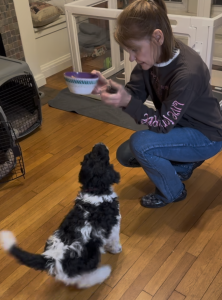
That simple exercise became the foundation for so many other behaviors. Waiting politely at the door, holding a “stay,” or responding to “leave it” all begin with learning self-control. In our experience, teaching impulse control is one of the most important lessons you can give a puppy. It establishes gentle leadership, builds trust, and lays the groundwork for a confident, well-mannered companion.
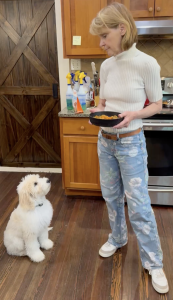
Click here to see another short video demonstration
Whether you’re bringing home one of our Goldendoodle puppies, Aussiedoodle puppies, Bernedoodle puppies, Golden Retriever or another family companion, establishing that leadership from the very first day can make a tremendous difference in your puppy’s future behavior. At Doodle Patch Farm, we often tell families throughout Dayton, Cincinnati, Columbus, and surrounding Ohio communities that many behavior challenges can be prevented through simple, consistent daily routines that build trust, respect, and a lifelong bond between you and your puppy.
Why Controlling Food Is One of the Most Important Things You Can Do for Your Puppy
One of the most valuable puppy training tips new dog owners can learn has nothing to do with leashes, crates, or obedience classes. It begins with something your puppy thinks about every day: food.
When most people bring home a new puppy, they focus on potty training, chew toys, sleeping arrangements, and puppy-proofing the house. While all of those things matter, there is one simple practice that can have a profound impact on your puppy’s behavior and your relationship for years to come:
You should control the food.
Food is one of the most valuable resources in your puppy’s world. How you manage that resource helps establish leadership, trust, respect, and communication from the very beginning. Developing healthy feeding habits is one of the foundations of raising a well-behaved dog.
Leadership Begins at the Food Bowl
Dogs are social animals that naturally look for guidance and structure. In a healthy relationship, your puppy should view you as the trusted leader who provides resources, direction, and security.
One of the easiest ways to establish this leadership role is through feeding.
When you prepare the food, ask for a simple behavior such as a sit, and then give permission to eat, you are teaching your puppy several important lessons:
- Good things come through you.
- Patience is rewarded.
- Self-control brings opportunities.
- Looking to you for guidance is worthwhile.
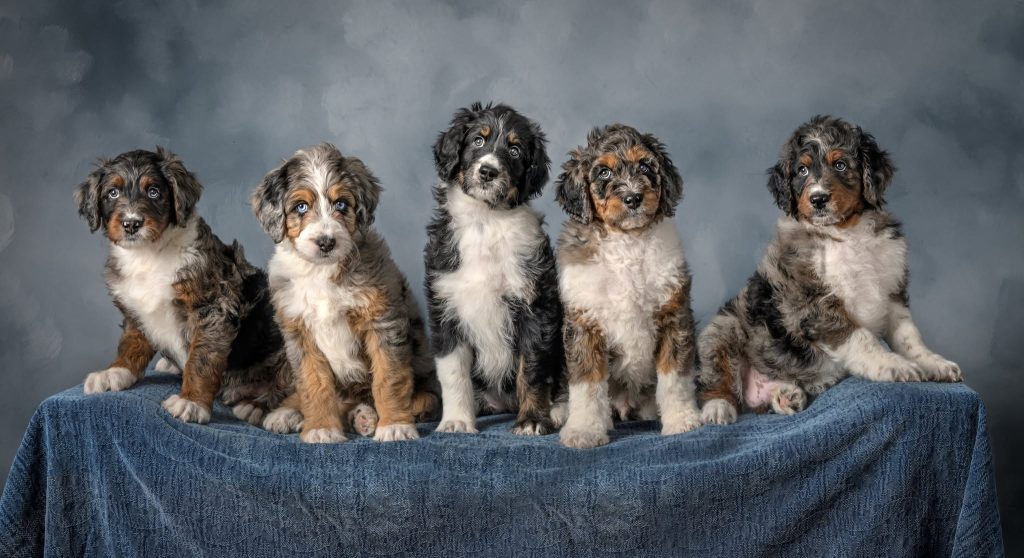
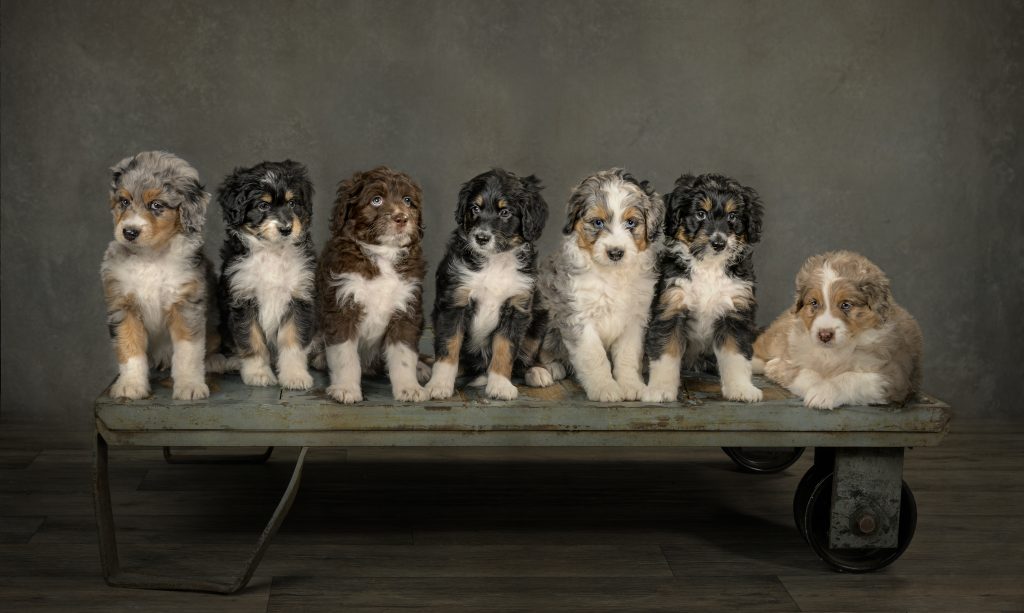
Past litter from this pair
Your puppy begins to understand that you are not simply the person who fills the bowl. You are the provider and decision-maker.
For families wondering how to become your puppy’s leader, mealtime offers a simple, positive, and effective place to start.
Every Meal Is a Training Opportunity
Most puppies eat two or three meals every day. Over the course of a year, that’s more than 700 opportunities to reinforce desirable behavior.
Instead of simply putting down a bowl and walking away, use mealtime to practice:
- Sitting calmly
- Making eye contact
- Waiting politely
- Responding to their name
- Following simple commands
These exercises only take a few seconds, but they build habits that carry over into everyday life.
A puppy that learns patience around food is often more capable of learning patience in other situations as well.
This is one of the most effective methods for teaching puppy self-control, because the reward is highly motivating and naturally reinforces good behavior.
Self-Control Around Food Leads to Self-Control Elsewhere
One of the greatest gifts you can give your puppy is the ability to control impulses.
Puppies naturally want what they want immediately. They want to rush through doors, jump on visitors, chase squirrels, grab dropped food, and pull toward exciting distractions.
Teaching a puppy to wait for permission before eating develops a foundation of self-control.
The lesson becomes: “I don’t have to act immediately. I can look to my human first.”
That mindset can help with:
- Greeting guests politely
- Walking on a leash
- Coming when called
- Waiting at doorways
- Respecting boundaries
- Living peacefully with children and other pets
The food bowl becomes the classroom where many future behaviors begin.
Hand Feeding Builds Connection
Many professional trainers recommend occasionally hand feeding part of a puppy’s meal.
This doesn’t mean every meal must come from your hand. However, periodically feeding kibble during training sessions helps your puppy associate you with positive experiences and rewards.
Hand feeding can:
- Strengthen your bond
- Increase attention and focus
- Improve responsiveness
- Reduce food possessiveness
- Create positive training experiences
Your puppy learns that interacting with you is rewarding and enjoyable.
For dog owners seeking positive leadership for dogs, hand feeding can be a valuable tool for building trust while reinforcing manners and attentiveness.
Avoid Free Feeding
Free feeding means leaving food available all day and allowing the puppy to eat whenever they choose.
While there are exceptions for certain dogs and situations, most trainers and breeders recommend establishing consistent feeding routines for puppies.
Scheduled meals provide several advantages:
- Easier house training
- Better monitoring of appetite and health
- More training opportunities
- Clearer routines
- Increased motivation during training
When food is always available, its value decreases. When food is provided through structure and routine, it becomes a powerful teaching tool.
Consistent feeding routines for puppies help create predictable expectations and encourage puppies to look to their owners for guidance throughout the day.
Leadership Is Not About Dominance


When discussing pack leadership, some people immediately think of harsh corrections or outdated dominance theories. That is not what effective leadership means.
Good leaders provide:
- Consistency
- Fairness
- Clear expectations
- Protection
- Guidance
- Resources
Your puppy should never fear you.
Instead, your puppy should trust you.
Controlling food is not about intimidation. It is about establishing a healthy relationship where your puppy learns to look to you for direction and guidance.
The most successful dog owners are not those who try to overpower their dogs. They are the ones who consistently demonstrate calm, confident leadership.
This approach is the foundation of positive leadership for dogs, where respect is earned through consistency rather than force.
The Long-Term Benefits
The habits you establish during the first few weeks and months can influence your dog’s behavior for years.
When you consistently control the food and use meals as opportunities to reinforce calm behavior, you are building:
- Respect without fear
- Trust without force
- Cooperation without conflict
- Attention without constant correction
Your puppy learns that listening to you leads to good things.
That lesson extends far beyond the food bowl.
For families interested in raising a well-behaved dog, these small daily interactions often have a greater impact than occasional formal training sessions.
A Simple Routine to Start Today
At each meal:
- Prepare your puppy’s food.
- Ask for a sit.
- Wait for calm behavior.
- Lower the bowl.
- If your puppy breaks position, lift the bowl and try again.
- Release your puppy with a word such as “Okay” or “Free.”
- Allow them to eat.
Here is what this looks like: Video demonstration of puppy feeding.
The entire process takes less than a minute but teaches valuable life skills every single day.
Final Thoughts
The food bowl is much more than a feeding station. It is one of the most powerful training tools available to puppy owners.
By controlling food and using meals as opportunities to teach patience, self-control, and attentiveness, you help your puppy understand an important truth: You are the trusted leader who provides guidance, structure, and security.
That foundation can make the difference between a dog that constantly challenges boundaries and one that happily looks to its family for direction.
At Doodle Patch Farm, we believe successful puppy raising starts with simple daily habits. Few habits are more powerful than structured mealtimes, thoughtful feeding routines for puppies, and a commitment to teaching puppy self-control through positive interactions.
If you’re searching for practical puppy training tips, learning how to become your puppy’s leader, and raising a well-behaved doodle, start with the food bowl. The lessons learned there can last a lifetime.
Doodle Patch Farm is a dog small ethical breeder located in South West Ohio near Dayton, about 30 minutes from Cincinnati, and one and a half hours from Columbus and Indianapolis. All of our breeding dogs have genetic testing and OFA certifications. Visit our website at DoodlePatchFarm.com
